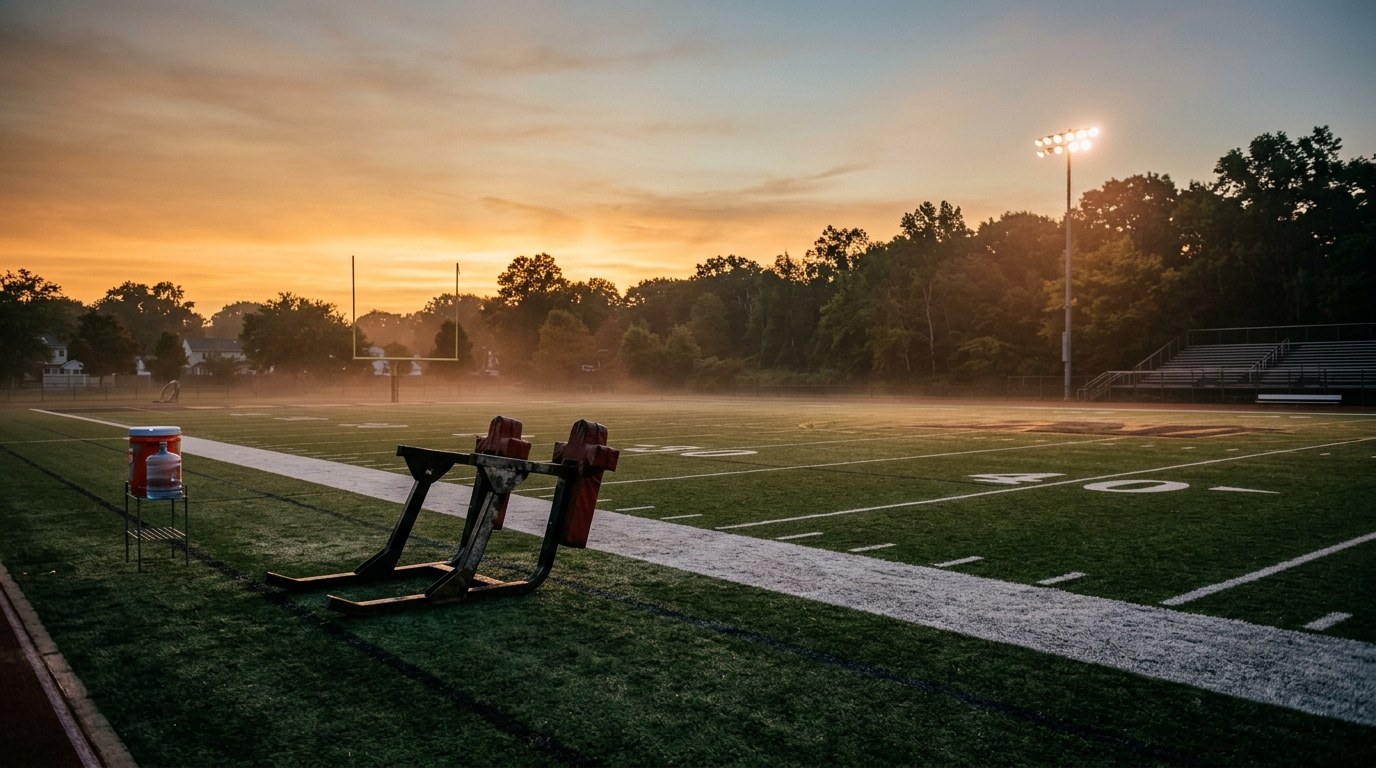
Training in summer heat on the Jersey Shore is real training, not survival — but heat acclimatization takes 7 to 14 days of exposure, and once fluid loss crosses 1 to 1.5 percent of body weight, performance drops and injury risk climbs. Here's how July and August work in Ocean Township without cooking anyone.
There is a version of summer training on the shore that looks like a workout and functions like slow damage — an athlete who was fine in June, gassed by mid-July, dragging by August, and behind the ones who trained smarter. Heat is a training stressor like any other stressor: dose it right and it builds you tougher; dose it wrong and it hurts the season on the other side. What follows is how we run summer training with athletes from Ocean Township, Oakhurst, Long Branch, Asbury Park, Eatontown, Neptune, and Tinton Falls — whether the goal is a football preseason, staying sharp between seasons, or just getting through July intact. Updated July 2026.
Should You Train Outside When It's 90°F and 75% Humidity Here?
Yes — but only if you are already heat-acclimated, and only at a scaled-down intensity, with a specific rule for what the wet-bulb globe temperature does to the session. The number on the thermometer is not the number your body reacts to. Wet-bulb globe temperature (WBGT) folds air temp, humidity, wind, and radiant heat into one number, and it is the number athletic trainers, the military, and anyone serious about heat use.
Here is the rule we run:
- Green zone (WBGT below 82°F): a normal session runs normally.
- Amber zone (WBGT 82 to 87°F): cut duration to about 60 minutes at 6 to 7 out of 10 intensity, with a 5-minute cooling break every 20 minutes. This is roughly any humid mid-July morning here after 9 AM.
- Red zone (WBGT above 87°F): outdoor high-intensity work moves inside. Full stop.
We run the Ocean Township outdoor sessions at 6:30 AM through July and August because by 9 AM the coastal humidity climbs into the mid-70s and the wet-bulb globe temperature at field level regularly hits the 82°F line that shifts a session from build to survive. Same air, same field, same athlete — three hours changes what the session is.
What's the Real Physiology of a Jersey Shore Summer Session?
You sweat harder, cool worse, and drift higher in heart rate at the same effort — because humid ocean air won't take your sweat off your skin, so it can't do the one job sweat has. Evaporating sweat is what cools you. In the 75 percent humidity that hangs over Route 35 most July mornings, sweat pools instead of evaporating. That is the whole problem in one sentence.
The numbers on a hot Jersey Shore session: a well-trained athlete sweats 1.0 to 2.5 liters an hour, and a hard 90-minute session can push past 3 liters. Heart rate drifts up 5 to 15 beats per minute across the session at the same effort — that is cardiac drift, your body borrowing capacity to cool itself instead of to move. Core temperature climbs a fraction of a degree every 15 to 20 minutes if the load isn't managed. Ocean Township at 80°F and 75 percent humidity has a heat index in the high 80s to low 90s and a WBGT that behaves the same way. Same thermometer reading as a dry Denver morning, very different session.
Why does the same 80°F feel harder here than out west?
Because the humidity blocks evaporative cooling. Sweat that doesn't evaporate doesn't cool. Athletes who spend a week in Colorado in July and come back to a Jersey Shore August feel it immediately — same work, but the cooling side has to work twice as hard, and the load lands as extra fatigue and worse recovery between reps. The takeaway isn't that humidity is scary; it's that the load has to be planned around the day. A perceived-effort of 7 in dry air is an actual physiological effort of 8 or 9 in humid air. If you don't adjust, the second half of every session becomes fake work.
How Long Does Heat Acclimatization Actually Take?
About 7 to 14 days of daily exposure builds roughly 80 percent of the adaptation, and a full 21 days locks it in — which means the athlete who takes June off and starts training July 5 is playing catch-up all month. Heat acclimatization is real and measurable: plasma volume expands, sweat rate goes up and starts earlier, sweat becomes less salty so you keep more of your electrolytes, and heart rate at a given workload drops. It also fades — miss five or more days in AC and you lose about half of the adaptation and need a 5 to 7 day rebuild.
Here is the ramp we use for athletes who haven't been in the heat yet:
- Days 1 to 3: 20 to 30 minutes of easy-to-moderate work outdoors. This is a heat exposure, not a workout. You will feel worst here. Push through it.
- Days 4 to 7: 30 to 45 minutes of moderate work. Add short pieces of harder effort — 60 to 90 seconds — but don't chase intensity yet.
- Days 8 to 14: Full sessions at the intensity the WBGT allows. By day 10 to 14 the sweat has changed, the resting and working heart rate has come down, and the same session that felt like 8/10 in week one feels like 6/10.
- Day 15 and beyond: You're acclimated. Maintain it by training in the heat 3 to 4 days a week — a fully air-conditioned week resets the clock faster than most athletes realize.
The rule inside the ramp: daily exposure is what builds it. Two hard days a week plus five in the AC does not produce acclimatization. If the athlete is coming off a two-week vacation in an air-conditioned house, they are back near day one and the intensity has to reflect that.
What Should a Hydration Plan Look Like for a 90-Minute Summer Session?
Aim for a 2 percent body-weight loss ceiling — the line where performance falls off and thinking slows down — and structure fluids in three windows: before, during, and after. No magic drink; a simple plan most athletes don't run.
- Two hours before: 16 to 20 ounces of water with a pinch of salt or an electrolyte tab. Enough time to hit the bloodstream, not so much you're peeing through warm-up.
- During: 6 to 8 ounces every 15 to 20 minutes. For sessions over an hour or in the amber WBGT zone, add sodium — 300 to 700 mg per liter — because plain water in a heavy salty sweater is where cramps come from.
- After: replace what you lost. Weigh in before and after. Drink 20 to 24 ounces of fluid per pound of body weight lost, and eat something with real sodium inside the next hour.
The two mistakes we see every summer: over-drinking plain water before a session (dilutes sodium, feels worse not better) and under-drinking after (the next day's session pays for it). Cross a 2 percent body-weight loss and output drops noticeably. Cross 4 percent and you are in trouble — that is where cramps, poor decisions, and heat illness live. The scale is not a vanity tool in July; it is a training tool.
When Should You Move Inside — and What Are the Real Warning Signs?
When the wet-bulb globe temperature crosses 87°F, or when any single one of five body signals shows up, the outdoor session ends. That is not a soft rule. That is the rule.
- Heart rate that won't recover between reps. Normally HR drops back down inside the rest interval. When it plateaus and won't drop, cooling is failing.
- Sweating stops in a heavy session. If you were pouring and then aren't, and you don't feel colder, that is a red flag — get out of the sun and cool aggressively.
- Skin goes pale, clammy, or gets goosebumps in the heat. Thermoregulation is losing.
- Confusion, dizziness, headache, nausea — or the athlete gets quiet. A talker who suddenly stops talking is one of the clearest early signs of heat exhaustion.
- Cramps that don't resolve with fluid and electrolytes. A single calf cramp on a hot day is a warning. Full-body cramping ends the session.
If any of the last three show up, the day is done. Move into shade or AC, cold fluids in, cold towels on the neck and inside of the arms and thighs. If the athlete doesn't clear inside 15 minutes, get medical help — heat exhaustion becomes heat stroke fast, and heat stroke is a medical emergency. This is not a place to be tough about it. This is educational information about training practice, not medical advice.
How Do You Keep Progressing Instead of Just Surviving the Season?
Move the hardest work into the coolest window, shift the training emphasis toward what the heat protects, and use the season as a real building block instead of a survival month. Progress in July and August looks different than progress in April, but it is real progress — and the athlete who plays it right walks into September ahead, not behind.
- Move max-effort work to the coolest window. Before 8 AM or after 7 PM outdoors, or indoors and air-conditioned at any time. Sprint work, heavy strength, and high-intensity conditioning belong there — not at noon in a July parking lot.
- Shift the balance toward strength. Indoor strength work is heat-neutral. Two or three heavier lifting days a week move the needle even when outdoor conditioning has to scale down.
- Use the pool. Water sessions train aerobic base and unloaded conditioning without stacking heat load on the body — a real gap-filler on red-zone days.
- Double down on mobility and soft-tissue work. Recovery quality goes up when you are not fighting to cool down inside every workout. The offseason bodywork that gets skipped when it is cool has a much better window now — see what sports massage actually does for the timing on that.
- Sleep gets harder — and matters more. Hot bedrooms wreck sleep, and heat load in the day plus poor sleep at night is how a summer of training becomes a summer of feeling stuck. AC on, room cool, blackout curtains. The recovery half of the program has to hold up — that's the whole logic in why every program here is half recovery.
A summer block that includes real heat acclimatization, an honest hydration plan, and a session structure that respects the WBGT does two things at once — it protects the athlete now, and it stacks the adaptations that make September training feel easier. That is not surviving. That is building through it. Football players heading into camp in mid-August need this dialed by early July — the exact ramp is in the six-week football preseason plan for Ocean County, and the summer heat rules run underneath it. Summer is also when speed work has to move to the cool windows to stay high-quality, and knowing your real numbers helps you tell progress from a hot-day slump, see speed benchmarks for high school athletes.
Frequently asked questions about training in the summer heat
What time of day is safest for outdoor training in Ocean Township in July and August?
Before 8 AM or after 7 PM — those are the windows when the wet-bulb globe temperature at field level is most often in the green or low-amber zone here. By 9 AM most July mornings on the Route 35 corridor, humidity has climbed into the mid-70s and the WBGT is at or over the 82°F line where session structure has to change. Mid-afternoon is the worst window and there's no version of it that isn't a compromise.
Can you train hard in high humidity if you're used to it?
Yes — that is the whole point of heat acclimatization. Once you have built the adaptation over 7 to 14 days, the same 85°F and 75 percent humidity morning that would have been a hard session for someone unadapted is now a normal session for you. You still hydrate, still watch the WBGT, and still move indoors above 87°F WBGT — but the tolerance for the middle zone is real, and it is why we build heat exposure into summer training instead of dodging it.
How much water should I drink during a 90-minute summer training session?
6 to 8 ounces every 15 to 20 minutes during the session, with 16 to 20 ounces about two hours before, and 20 to 24 ounces per pound of body weight lost afterward. On any session over an hour or in the amber WBGT zone, add sodium — 300 to 700 milligrams per liter — because plain water in a heavy sweater is where cramps come from. Weighing in before and after tells you if you got it right.
What is the difference between heat cramps, heat exhaustion, and heat stroke?
Heat cramps are painful muscle spasms tied to fluid and sodium loss; they respond to rest, fluids, and electrolytes. Heat exhaustion is heavy sweating with dizziness, headache, nausea, weakness, and elevated heart rate — end the session, cool down, get fluids in. Heat stroke is the medical emergency: core temperature over 104°F, confusion or disorientation, sometimes stopped sweating. Call 911 and cool aggressively — cold-water immersion when available. Educational information, not medical advice.
Should kids train through the heat the same way adults do?
No. Younger athletes need a slower ramp, more frequent breaks, and a lower ceiling. Kids have a higher surface-area-to-mass ratio, they can't sweat as efficiently until later in adolescence, and they don't always recognize thirst or fatigue as fast — so we lean on shorter sessions, more shade, forced hydration breaks every 15 minutes, and a strict move-indoors line at WBGT 85°F for youth (versus 87°F for older athletes).
Do you cancel outdoor sessions on heat-advisory days?
We move them, not cancel them. Indoor strength work, mobility, hands-on bodywork, and skill sessions at the studio are all heat-neutral and stay on the schedule. The outdoor pieces — sprints, field conditioning, agility — move to the coolest window of that day or shift indoors. The training block doesn't stop; the tool used to build it changes.
How does 1st & Goal handle summer training?
We build the summer around the athlete — the sport, the schedule, what they're coming back from, what September needs to look like — and we structure sessions by the day's WBGT, not by the calendar. Outdoor conditioning in the cool windows, indoor strength through amber and red days, hydration planned around body-weight losses, and bodywork layered in on the harder weeks. We see athletes from across Ocean and Monmouth County — Ocean Township, Oakhurst, Asbury Park, Long Branch, Eatontown, Neptune, Tinton Falls, and beyond. If you want a real plan for the next eight weeks instead of guessing your way through July, get in touch or walk through the services. If you're in Long Branch specifically, the Long Branch training page is the walk-through.