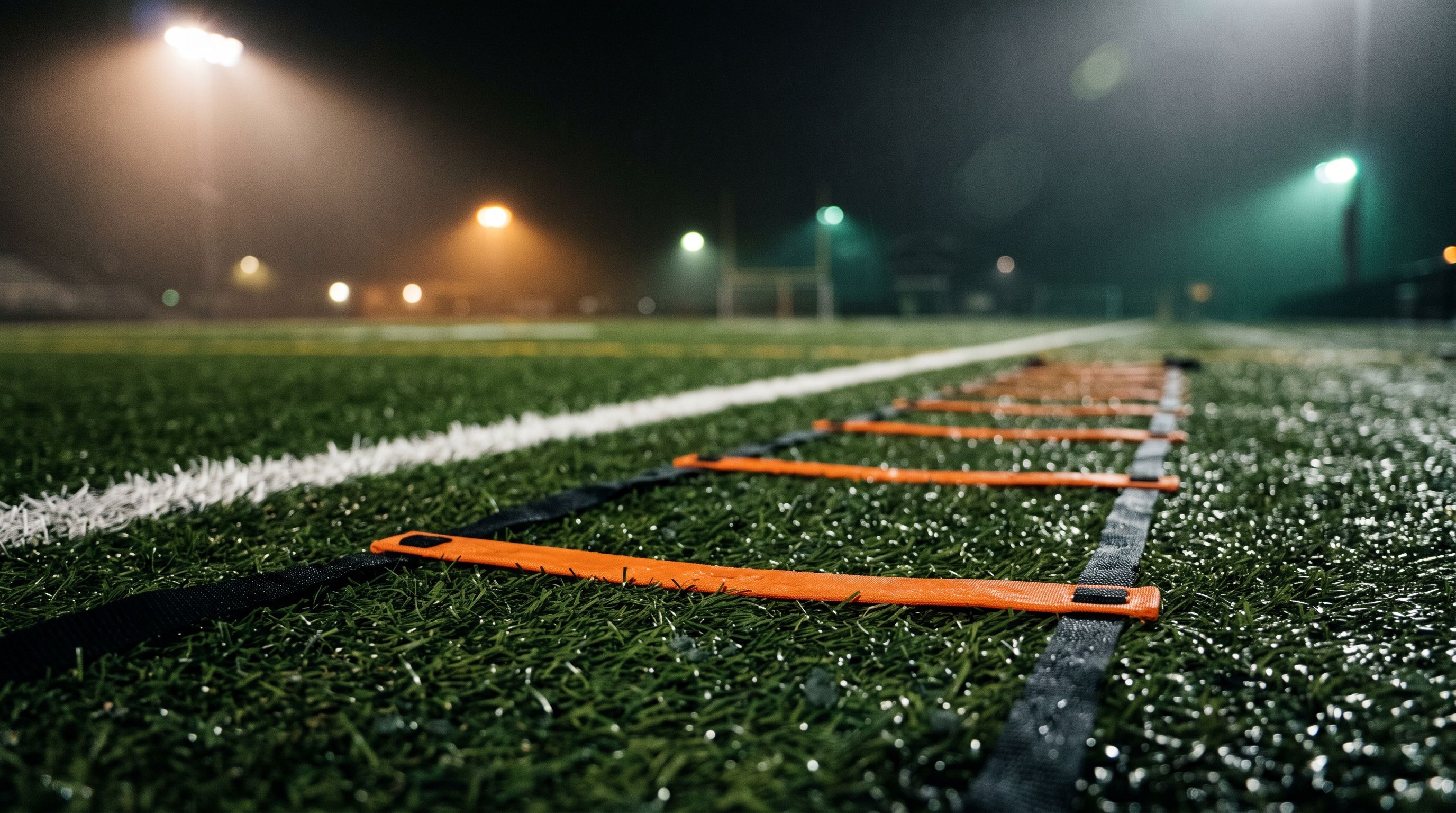
No. An agility ladder does not make an athlete faster, and it will not fix a slow cut either. What it is good for is the first five minutes of a session: foot contacts, rhythm, waking up the ankles and feet before anything hard happens. That is a real job. It is just not the job the ladder gets sold for. Speed is force into the ground and how fast you put it there, and in a ladder your foot touches the floor for a fraction of a second at almost no load, over and over, going nowhere in particular.
Updated September 2026. We get asked this every fall, usually by a parent whose athlete has been doing ladder work twice a week since July and has not run any faster. Nothing is wrong with the ladder. Something is wrong with what it was asked to do. We have written a version of this before, in the real difference between speed and agility training: cones and ladders train pre-planned footwork, where the athlete already knows the route. This post is about the ladder by itself, because it is the most common piece of equipment in youth speed training and almost nobody can say out loud what it is for.
Start With What the Ladder Is Good At
Give it credit first, because it earns some.
A ladder is a clean way to get an athlete moving before you ask anything real of them. It raises tissue temperature, it gets the feet and ankles firing, and it does that in a small space with nothing but the ladder. For a 12-year-old who has never been coached, it teaches something genuinely worth having: the feeling of putting a foot exactly where you meant to put it. Coordination at no load is still coordination.
It is also fun, and that matters more than coaches like to admit. A group of kids will attack a ladder drill with energy they will not bring to the fourth set of a heavy trap bar pull. Five minutes of that at the front of a session buys you a better next forty.
So we use ladders. We use them where they belong, which is the warm-up, and we do not count that time as speed work.
Why It Stops There
Here is the mechanical reason the transfer does not happen.
Sprinting fast means hitting the ground hard, in a specific direction, with a short contact time and real force behind it. A top-speed stride puts a multiple of the athlete's body weight through one leg in around a tenth of a second. A ladder rep asks for close to the opposite: light, quiet, small, and deliberately not pushing off, because a hard push would carry you past the next square.
The drill is not a gentler version of sprinting. It is a different movement that happens to use the legs quickly. A body gets better at what it actually rehearses, and what a ladder rehearses is stepping precisely inside a fixed pattern you memorized on the first rep. A ladder square never moves. It has never once forced an athlete to decide anything.
That is also why ladder work does not repair change of direction. What limits a cut is almost always the ability to slow down, and a ladder never asks anyone to brake from speed.
The Test That Would Settle It
If a ladder block were building speed, there is one place it would have to show up.
On a first assessment here we run a 10-yard fly and a 5-10-5 pro agility shuttle on the same day and read the gap between them. The fly is straight-line acceleration with nothing in the way. The shuttle is two hard brakes and two reversals in under five seconds. Those two numbers tell us which quality is holding an athlete back, and they are what we retest against every three to four weeks, same surface, same start, same clock.
Run that honestly and the ladder question answers itself. Six weeks of ladder work, done properly, with nothing else changed, should move one of those two numbers if the claim is true. Pick the number your athlete's sport actually needs, write it down before the block starts, and go look at it in a month. Most people never write it down. That is the real reason the drill survives.
I will put my opinion on the table. I would rather an athlete own ten clean decelerations out of a real sprint than forty perfect ladder patterns, and it is not close.
What Actually Puts Time on the Clock
The honest list is shorter and duller than the ladder.
Sprint. Actually sprint, full effort, in short doses, early in the session while you are fresh, with long rest between runs. Speed is a nervous-system skill and it only trains when the athlete is not tired.
Get strong. The force has to come from somewhere, and for most high school athletes the quickest available gain is still a stronger lower body.
Learn to brake. Deceleration is what makes a sharp cut possible, and it gets taught from low heights and short distances long before anyone loads it.
Then add a read. Mirror drills, a live partner, small-sided chaos where the direction change is an answer to something instead of a memorized route. That is the piece a ladder structurally cannot give you.
Our division programs run two, three or four sessions a week depending on what the athlete needs, and none of those slots go to ladder patterns. How the programs are built is laid out on the services page.
If a Ladder Is the Whole Program
This is the practical version of the question, for a parent standing at the fence watching a session.
Ask what the ladder is for. If the answer is warm-up, that is a good answer, and the rest of the hour is where you should be looking. If the ladder is the speed block, and the session is thirty minutes of footwork patterns with a stopwatch nowhere in sight, you are buying coordination work at speed-training prices.
The better question is what gets measured. A program that tests, writes the number down, and retests under the same conditions will eventually find out whether the thing it sells works. A program that never tests can sell a ladder forever.
We work with athletes from across Monmouth County, and the Tinton Falls training page covers what that looks like for travel-team families coming down Route 35. To get the fly and the shuttle measured on your own athlete, and find out which one is actually the problem, get in touch.
Questions We Get About Ladders
Do agility ladders improve foot speed?
They improve your foot speed inside a ladder. Moving the feet quickly through a memorized pattern at almost no load is a skill, and you will get better at it with practice. It does not carry over to a sprint, because a sprint is decided by how much force the foot puts into the ground, not by how many times it touches down. Fast feet and a fast athlete are two different things. That is also the honest answer to whether a ladder is a waste of time: it is not useless, it is mislabeled, and the cost is the slot it takes from real sprinting.
What should replace ladder work in a speed program?
Short full-effort sprints while fresh, lower-body strength work, deceleration taught on purpose, and change-of-direction drills that include a live read. That is most of it. If the athlete plays a sport where the cut is the whole job, the braking work matters more than anything you can do on a flat ladder, and it is the piece almost every youth program skips.